A treasure trove from cousin Mike!

I have been eagerly watching my mailbox for the past week, waiting for a very special delivery to be made from Mike Wise in Georgia.

It arrived on Thursday, just as cousin Mike’s postmaster had promised.

What a treasure trove! And how generous of Mike to send me the disk with his Wise Guys family newsletter on it, along with personal research and photos.

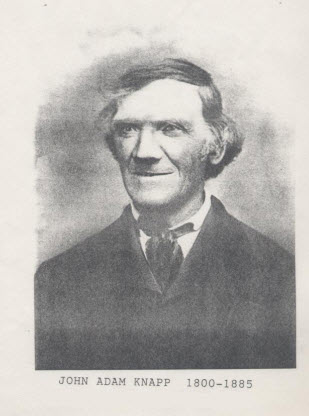
And speaking of photos – check out the photo of our our immigrant ancestor’s younger brother, John Adam KNAPP. As far as I know, this is the only photo I have ever seen of him.

I think we can get some idea of what his brother, Franz Adam KNAPP, must have looked like. I don’t know if they resembled each other or not, but we can certainly speculate.

What an amazing find!

I have my own ideas of who he resembles, but let’s hear from the rest of the Knapp clan…does anyone think John Adam looks like any of our present-day Knapp family? Post a comment or two and let us know what you think.

And I just want to say a huge “thank you” to Mike Wise, for sharing his research with us. Mike has been at this for decades – and he a lot of great stories to share with us about the family.

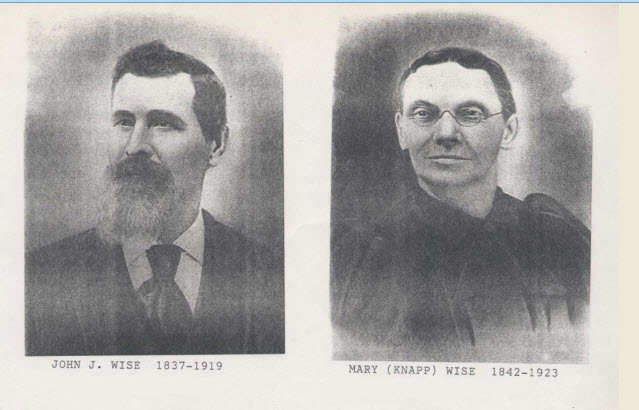
And here’s another sample of the great stuff yet to come: a photo of John Adam’s daughter, Mary KNAPP, with her husband, John J. WISE.

During the course of the next few weeks/months, I will be organizing and uploading Mike’s research and newsletters to Knapp Notes – so we can all enjoy them. So stay tuned for more information/updates in the near future.

l to r: John J. Wise and Mary Knapp Wise

Posted in Family History, Knapp, Photos, Wise | 5 Comments

Reasons why libraries are more important than ever

Our country’s founders understood the importance of an educated electorate. That’s why, as a society, we chose to support public education and what has been referred to as “the people’s university” – our wonderful system of public libraries.

As a writer, I value public libraries. Some of my happiest hours as a child were spent in the library. I learned to read at an early age, thanks to my mom. An avid reader, I didn’t just read books – I devoured them.

Many of our young people today view the local library as a safe haven and as a way to avoid the violence in the streets.

Consider what a library means during the Great Recession to our fellow citizens who are out of work? Libraries serve as a resource center, providing free access to computers, job search support, free or low cost computer classes and a host of other services which offer not a handout, but a hand up to a better job and a brighter future.

Many of our libraries’ budgets are now on the chopping block. But I strongly urge our politicians to consider the ramifications of cutting library budgets carefully before they act.

Now, more than ever before, there are a lot of hurting Americans who depend on these wonderful resources, our local libraries.

President John F. Kennedy understood the value of our libraries:

If this nation is to be wise as well as strong, if we are to achieve our destiny, then we need more new ideas for more wise men reading more good books in more public libraries. These libraries should be open to all except the censor. We must know all the facts and hear all the alternatives and listen to all the criticisms. Let us welcome controversial books and controversial authors. For the Bill of Rights is the guardian of our security as well as our liberty.

Read this great article about nine reasons why we every community needs to support its public libraries. The author says it much more eloquently than I could – please take a moment to read her article.

And when you have a chance to vote for a library levy or speak up when your local library is forced by budget cuts to close its doors or limit services, SPEAK UP and BE HEARD!

Posted in Libraries | Tagged | 1 Comment

Two heads of cabbage and why I write Knapp Notes

I began writing Knapp Notes in 2010 with four goals:

  1. To teach myself WordPress. For those of you that don’t know, I am a writer by trade. And for writers, blogs are where we shine nowadays.
  2. To share my genealogy research with other members of the family. But I didn’t just want to share a bunch of names, dates, events and places. I wanted to use my writing skill to tell people’s stories. It’s my way of ensuring our ancestors aren’t forgotten and their stories lost.
  3. Use Knapp Notes to communicate with other members of the Knapp clan about the reunions. I know we have Facebook, but blogs can do some things easier than FB can. And it is something I can control – FB can get a little cluttered.
  4. Re-establish connections with far-flung members of the extended Knapp-Kline family.  And with this goal, I believe Knapp Notes has been wildly successful. I have had many wonderful conversations with people who are distantly (and not so distantly) related across the United States. And even a few in the old country (Germany)!

It is goal #4 that brings me to the topic of this post.

I mentioned in my last post some conversations with a relative who is traveling here from Nebraska this week to do genealogy research on the May/Kline connections. Catherine is hoping to locate and photograph the May family homesteads while she is in Portage County.

Also this week, Michael Wise, who lives in Leesburg, Georgia, contacted me about sharing his family research with us. And judging from what he told me, I believe there is a disc loaded with family photos, stories and documentation wending its way north to us as I write this.

One of the most tantalizing aspects of Mike’s research is that he has recorded family stories as well as facts, events and dates. That is what makes our ancestors come alive right before our eyes. Receiving a cache of family stories is a priceless treasure to a genealogist. Stories are passed down by word of mouth and seldom recorded. So this is a real gem!

Here is one example which Mike shared with me during one of our email conversations:

A genealogist told me years ago that family histories are more than just dates of births, weddings, and deaths, she suggested that we interview older relatives and document their stories on tape or write them down and not to waste time to set up an interview because they are getting older every day. Family stories add color and depth to a family history and future generations can then see that our ancestors were not just immigrants who worked hard and died young.

I will leave with this little story of John Adam Knapp.

Now you already know that John Adam had all daughters, except for one son who died at about 19. Two of John’s daughters married Wise brothers. John J. Wise married Mary Knapp and Barney Wise married Rosina Knapp.

Another Wise brother, Joseph, wanted to marry Margaret Knapp and old John Adam put his foot down and said “NO !” “Two heads of cabbage from the same patch are enough.” Margaret never married and Joseph married Mary Anne Andes who lived just across the road from cousin Margaret.

Auf wieder sehen,

Michael Wise

See what I mean? I knew that John Adam Knapp had a son who died young, and the rest of his children were girls. And I also knew that two of his daughters married Wise brothers. And I knew the one daughter never married.

What I didn’t know was the rest of the story about WHY she never married.

And to have captured the exact phrase old John Adam used to object to the proposed marriage, well, that’s just priceless!

Thanks, Mike! I can’t wait to open the mailbox and see your disc when it arrives.

Stay tuned for more great stuff from Mike via Knapp Notes in the near future, folks!

Posted in Andes, Antes, Anthes, Family History, Kline/Cline/Klein, Knapp, Portage County, Stories, Wise | Tagged , , , , , | Leave a comment

Anyone know the location of May/Kline homesteads?

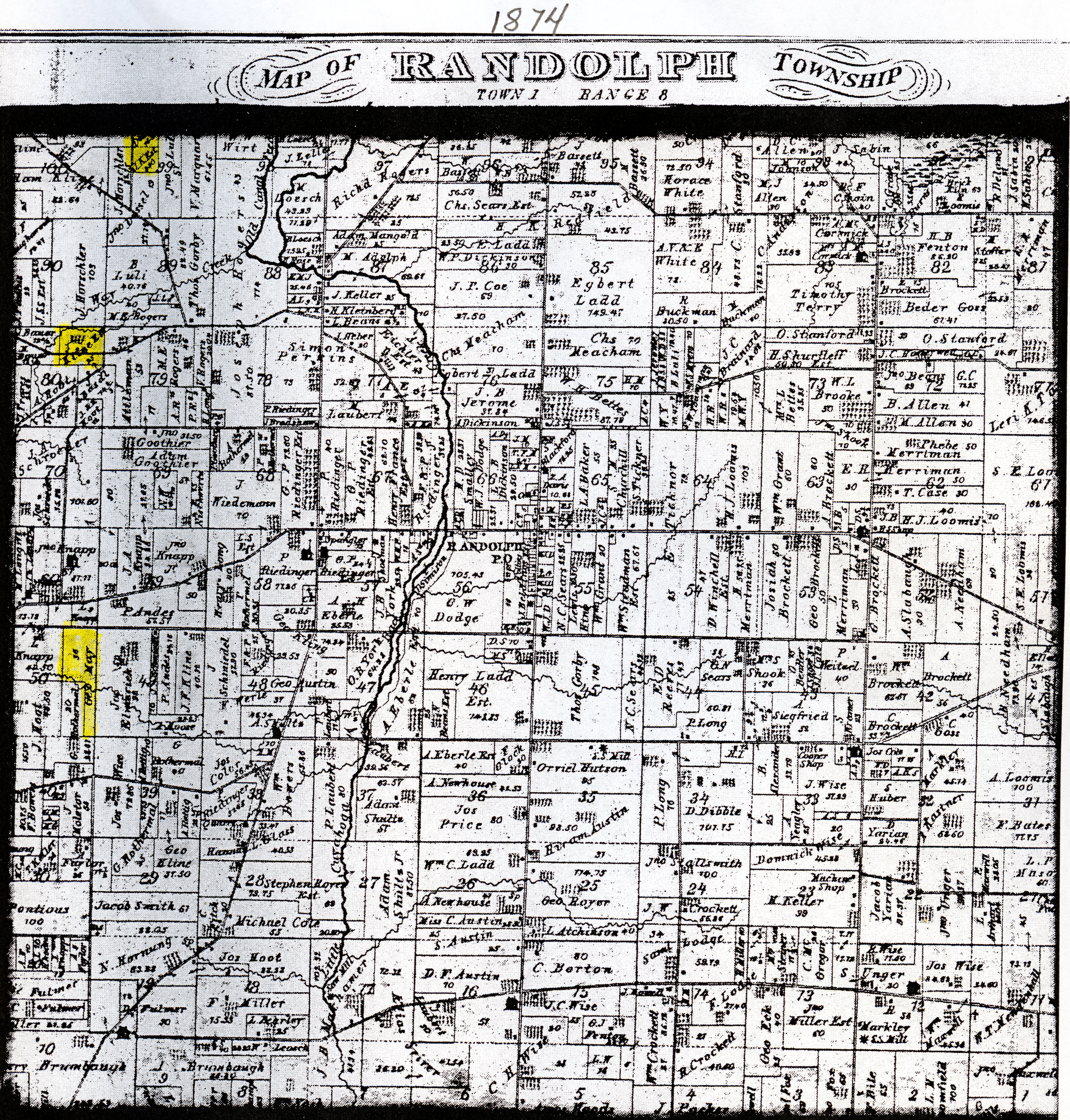
Randolph Twp. 1874 Plat Map

A few weeks ago, I was contacted by a May descendant who will be visiting northeast Ohio in October to do some family history research.

Catherine Renschler, who is also the Executive Director of  the Adams County Historical Society, located in Hastings, Nebraska, will be in the area to locate two May family homesteads in Portage County.

Catherine emailed me a plat map with the May homesteads highlighted, along with this note:

Attached is a scan of the 1874 plat map of Randolph township.

The top two farms marked in yellow were owned by my ancestor, John Kline (1820-1855). In 1874 they were still owned by his estate. The bottom farm marked in yellow was owned by George May. I think this may have been my ancestor George May (1796-18900. I plan to research this land at the Portage County courthouse.

I hope to locate these farms when I visit. You may post the scan at Knapp Notes if you want. It may be of interest to other family members.

I forwarded Catherine’s email to Uncle Gary Knapp so we can make plans to meet and help her locate and photograph the two properties.

If anyone else is interested in accompanying us or lending a hand, please contact Gary or I via Knapp Notes.

Posted in Family History, Kline/Cline/Klein, Local History, Maps, May | 5 Comments

An open letter to Congress: Fix the roof!

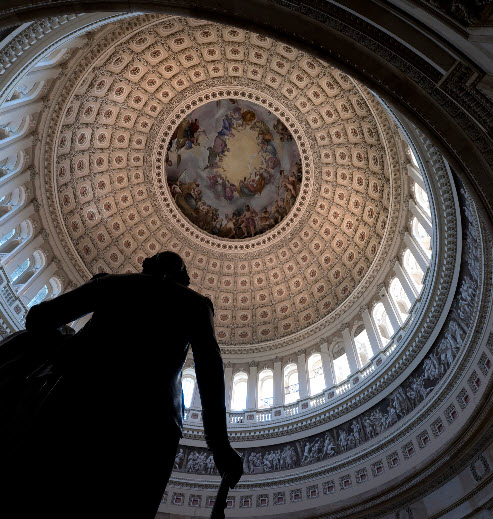
U.S. Capitol Rotunda near statue of George Washington

I realize economic times are tough for a lot of Americans – and for a lot of countries as well. Even the United States is facing a big challenge when it comes to funding infrastructure repairs to bridges, highways, public buildings, etc.

But when I ran across an item in the New York Times about the U.S. Capitol Building being in serious trouble due to more than 1,300 cracks in the building’s roof – well, it really bothered me.

I was fortunate back in the mid-1980’s to visit the U.S. Capitol. One of the highlights of our visit was standing in the middle of the Rotunda and gazing up in awe at the magnificent fresco painted on the Dome’s ceiling.

I don’t want to get into politics here – that’s not the purpose of this blog.

But I do wish to send a message to members of Congress to find a way to come together to fix the leaky roof of this building. It’s part of our history as a nation and a people – and it deserves to be preserved.

Unfortunately, the cost won’t be cheap – some $61 million, according to the article in the N.Y. Times.

But none of us would hesitate to fix our home’s leaking roof – so why the delay for one of our nation’s architectural and historical treasures?

View a 360-degree view of the Capitol’s Rotunda here and other parts of this grand old building as well.

This is a part of a wonderful website that provides a lot of information about the history of Capitol Hill buildings. You can also see high resolution photos of all of the art treasures housed in the Hill’s other public buildings. This site is worth a visit – the photos are great.

Posted in Preservation | Tagged , | Leave a comment

The case of the missing tombstone: Part 2

Thanks to a fellow genealogist, I learned more about the circumstances surrounding the “missing tombstone” today.

The plaque is located at the base of a memorial dedicated to Portage County’s Civil War veterans – not on the altar in the Our Lady of Lourdes grotto.

According to fellow researcher Ann Nikirk, the cemetery attempted to contact relatives of the deceased who were buried under the proposed Civil War veterans’ memorial site.

The cemetery documented the fact they couldn’t reach any descendants to ask their permission, so they put the Civil War memorial on top of the existing graves. I haven’t had an opportunity to visit the cemetery office to find out what documentation exists about this yet, but I would be curious to see if anything is still on file about their efforts to locate descendants and secure permission to relocate the graves.

John Adam KNAPP was the younger brother of the man who donated the land for the church. What an interesting situation that his grave now sits underneath a Civil War memorial, unmarked by an actual tombstone.

Now I am wondering if his wife is buried under there, too. Or did they move her and leave him there? I don’t really know what happened to her grave, but this is just another item to add to my research “To Do” list.

And a big thanks to researcher and Find A Grave contributor, Ann Nikirk, for shedding some light on this story – and keeping me honest!

Happy ancestor hunting!

Posted in Family History, Knapp, Local History, Ohio Churches, Portage County, St. Joseph Randolph | Tagged , | 1 Comment

The case of the missing tombstone…

I have visited the cemetery at St. Joseph Catholic Church many times, but while perusing one of my favorite genealogy sites, Find a Grave, I noticed something new.

A plaque located on the altar of Our Lady of Lourdes Grotto at St. Joseph Catholic Church in Randolph, Portage, Ohio, is pictured on this site. The plaque lists six early parishioners whose tombstones were used to build the outdoor altar back in 1919.

The six parishioners remembered on the plaque are:

  • Anthony Miller
  • Lawrence Rhodes
  • John Adam Knapp
  • Barbara Paulus
  • Maria E. Wise
  • Elisebeth Wise

John Adam KNAPP was the younger brother of our immigrant ancestor, Franz Adam KNAPP. He was born 21 Oct 1800 in Wald-Erlenbach, Hesse Darmstadt, Germany. He married Elizabeth ANDES on 28 July 1829 in Heppenheim, Starkenburg, Hessen, Germany. The couple had the following children:

  • Nancy Maryann KNAPP, who married John Lewis TRARES.
  • Elizabeth KNAPP, who married Nicholas HORNING.
  • Eva KNAPP, who married Joseph PAULUS.
  • Peter KNAPP, who died at the age of 20 and never married.
  • Rosina KNAPP, who married Bernard WISE.
  • Margaret KNAPP, who never married.
  • Mary KNAPP, who married John J. WISE.

John Adam KNAPP died 14 May 1885 in Randolph Twp., Portage, Ohio.

I have been trying to learn more about how the decision to use tombstones to build the grotto’s altar came about in the first place. It is reasonable to assume that marble and/or granite was costly for a small rural parish. A thrifty option was recycling the stone from tombstones.

Someone in the KNAPP family must have given permission for his tombstone to be used for this purpose. It was not his wife, since she had preceded him in death in 1871. And it wasn’t his son, Peter KNAPP, either. He died in 1860.

It must have been one of his daughters, possibly Margaret. Margaret never married and took care of her father after her mother’s death. John Adam KNAPP lost his eyesight in his later years.

The original family homestead passed into the hands of his daughter, Nancy Maryann KNAPP and her husband, John Lewis TRARES and later passed into the Paulus family by way of Frank W. PAULUS, a grandson, son of Joseph PAULUS and Eva KNAPP, who added modern comforts to the homestead such as running water, heat and electricity.

Also listed on this plaque are the names of other relatives, from the PAULUS and WISE families. I will write about them in my next series of posts.


Posted in Andes, Knapp, Local History, Ohio Churches, Paulus, Portage County, St. Joseph Randolph, Trares, Wise | Tagged , , , | 5 Comments

Civil War veteran finally laid to rest – 88 years after his death

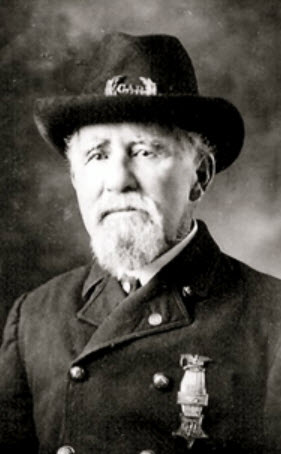
Peter Jones Knapp

I ran across an interesting story on Dick Eastman’s genealogy newsletter the other day that I just had to share.

Interestingly, it was about a Knapp – but not one of our Knapp ancestors.

Even more interesting (at least to me!) there is a connection to my hometown, Sandusky, Ohio.

When I first read the story of Peter Jones Knapp, I was fascinated. Then after I did some more research about him, I was awed by his strength and resilience.

And that’s when I knew I had to pass along this grand gentleman’s story.

It all started when Alice Knapp began researching her husband’s family tree. During her research, she learned of a 2009 newspaper article featuring her husband’s ancestor, Peter Jones Knapp. The story took a second look at a news item from 1921 in which a Confederate veteran named Willis Meadows coughed up a bullet.

Meadows had been shot in the eye during the Civil War – and the bullet remained embedded near his brain until it flew out of his mouth almost 60 years later during a coughing fit.

And if that isn’t incredible enough – there’s even more to this story…

The story made national headlines in 1921 – and, as a result, was read by an old man (Peter Jones Knapp) who living in Kelso, Washington. From the details mentioned in the story, Knapp concluded that HE was the Union soldier who shot Meadows at Vicksburg, Miss more than 60 years before.

He sent a letter to Meadows – and the two old veterans connected.

According to reporter Bill Miller, who wrote the 2009 article:

“As young mortal enemies they had tried to kill each other, but now, as aging veterans, they would spend their last few years as friends, exchanging photographs and wishing each other good health.”

After reading Miller’s article, Alice Knapp wanted to know where Peter Jones Knapp was buried. She found his obituary from the Kelso newspaper, which said memorial services had been held at a Portland crematorium.

She made a few phone calls and was astonished to learn that Knapp’s ashes were still sitting on a shelf and had never been claimed. She asked about the whereabouts of Knapp’s wife, Georgianna, who had died in 1930, and learned her ashes were still there, too!

According to his 1924 obituary, Peter Jones Knapp was born at Sandusky, Ohio, June 2nd, 1842, and was the youngest of 13 children. When he was 10 years old, his father died. Peter and an older brother kept the home together, working in the summer and going to school in the winter.

He had fought for the Union Army in many important battles, including Shiloh and Vicksburg. He also took part in the battle of Iuka, when 2,800 Union men opposed 11,000 Confederates. Out of 440 men in his regiment, 269 were killed or wounded (over 60 percent). War records show his regiment lost more men in this single engagement of one hour and twenty minutes than any other regiment lost in any one engagement during the war.

He also was taken prisoner at the battle of Missionary Ridge and was sent to Andersonville, a notorious Confederate prison where more than 12,000 Union soldiers died – most of them from starvation and disease.

Desperate to escape an almost certain death at Andersonville, Knapp decided to accept an offer to become a “galvanized Yankee.”

I thought I knew a lot about the Civil War, but this term was a new one for me. A “Galvanized Yankee” is a Union prisoner of war who is offered a way out of prison in exchange for swearing an oath of loyalty to the Confederacy and joining the fight against the Union.

Knapp saw this as an opportunity to escape the hell of Andersonville – and he took a chance.

But even this was risky. Some government officials wanted these men charged and tried for desertion/treason. Fortunately, at least one general had some compassion and argued for clemency.

After the war, Knapp married Georgianna Pearson in Muskegon, Michigan in 1870 and moved to Washington state. In 1887 he came to Kelso, where he engaged in the mill business, in which he had been interested in the South. Later, on his retirement, he was elected justice of the peace and police judge, in which offices he faithfully served for seven years.

No one knows WHY no one every claimed Peter and Georgianna Knapp’s ashes – frankly it was a miracle they were still in storage. But the fact that this veteran’s ashes was forgotten on a shelf for more than eight decades bothered Knapp – and she was determined to see that he and his wife finally laid to rest.

A family friend helped Alice Knapp arrange to have the couple’s ashes interred in Willamette National Cemetery in Portland, Oregon.

Knapp is the first Civil War veteran to be laid to rest in Oregon’s largest military graveyard.  On Friday, April 13, 2012, he was buried with full military honors provided by the Oregon National Guard. It was the anniversary of his death and also was the 151st anniversary of the Confederate victory at Ft. Sumter.

The burial attracted veterans, historians, Civil War re-enactors and curious onlookers. Brigadier General Eric C. Bush of the Oregon National Guard was one of the speakers at the service.

A miraculous story of forgiveness and reconciliation…and of courage, resilience and mercy. And thanks to the efforts of a determined genealogist and her sister-in-law, Peter and Georgianna Knapp are finally home.

————————————————————————————–

There is a lot more to Peter Jones Knapp’s story than I have written here. Please take the time to click on ALL the links below and read more about him. And – even more important – share this with your kids and/or grandkids.

Link to a moving YouTube presentation about Peter Jones Knapp.

Link to Find-A-Grave’s information about Peter J. Knapp’s obituary and a moving account of his life and bravery during the Civil War, his marriage to his wife and his service to his community after he retired from his sawmill business.

See the news coverage here. Read more about what a “galvanized Yankee” really is on Wikipedia.

Posted in Genealogy News, Knapp | Tagged , , , | Leave a comment

John W. Palm (1881 – 1925): Part 2

John Palm

I know I started this series of posts about the men shown in an old photograph of the St. Joseph Band some time ago. Sorry I had to put it down for awhile.

But the KNAPP family has been pretty busy the past year or so, dealing with health issues, weddings and other events.

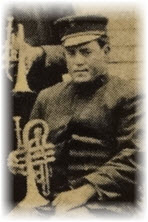
But I decided to pick up where I left off with John PALM. He is the trumpet player in the photo. Although it might be a coronet. I am not sure.

Sometimes when you’re doing genealogical research, you don’t always have every piece of the puzzle. It can take years before you find the last piece that allows you to make the connection. So anything that looks promising, you record and store for later review, as more data becomes available.

That’s a pretty good description of where I am with John PALM and his mother, Katherine KNAPP Palm.

Awhile back, while researching something else, I stumbled on a reference to an Adam KNAPP, born in April 1817 in Germany, who married Eva whose last name may have been CLUTTY or CLUTE. Eva was born in 1837 and died in 1861 in Suffield Twp., Portage Co., Ohio. The couple had a daughter, Katherine KNAPP, born 4 March 1860. Katherine/Kate/Catherine, and who died 29 Dec 1915 in Suffield Twp., Portage Co., Ohio.

At the time, I didn’t make the connection between any of our KNAPPs, but I filed it away anyway. That didn’t mean I didn’t have my suspicions, of course.

I was pretty darn sure there was a connection – especially when you take a look at the 1900 U.S. Census, which shows Michael Palm, his wife, Katie, and son, John Palm, living with Adam Napp, age 83. I believe that this is Katie’s father, Adam Knapp.

I believe there is a strong possibility that Adam KNAPP is related to our Suffield Knapps.

It is very telling that he appears in the photograph of the Randolph Band, since practically all of the band members are related in some way.

I don’t have proof or documentation yet – just a hunch.

I am still working on making that connection. I will find it – someday.

I did manage to get out to St. Joseph’s Cemetery and photograph John Palm’s resting place, along with the graves of his parents, Michael and Katie Palm.

Although I have no definitive proof yet, I think there is enough evidence to suggest it is highly likely that John PALM is also related to the KNAPP clan, through his mother, Katherine (Katie) KNAPP PALM.

The PALM family came from hardy German pioneer stock, as you can see from reading John W. PALM’s grandmother’s obituary. Below is the obituary of Mary Eva Elise BAUCH/BAOUCH. It is very informative, as it explains exactly how the PALM family came to Randolph, Ohio.

Obituary of Mary Eva Bauch – December 1904

Marie Eva Elise Bauch (Baouch) was born May 7th, 1824 in Laxidenbach, Baden, Germany. She was the daughter of Marx and Catherine Reiterman Baouch. With her parents, one sister and brother she came to this country in l847. It took them sixty-one days to cross the ocean on a sailing vessel. When they landed in New York, she remained with friends while the rest of the family came on to Ohio to join other relatives. One year after she married John Adam Palm, who came to this country from Hampistupt, Bavaria, a province of Germany in the year 1828. They continued in New York State until 1852 when with their three children they came to Ohio by way of Buffalo and Lake Erie to Cleveland. They traveled part of the way from Cleveland to Rootstown in wagons and were exposed to cold and rough weather.The children took sick on the way and all three died soon after reaching Rootstown.

They bought a small piece of land in the southwest part of Rootstown township where they built then a home and where the deceased lived for more than fifty years.

There were nine more children born to them, all living except one daughter who died October 1st, 1870 aged seven years. Her husband died on March 15th, 1871, in his fifty second year. Last April, she left her old home to make her home with her children. She died at the home of her daughter, Mrs. Kate Byers, in Ravenna, aged 80 years, 6 months and 22 days. The funeral services were held at the church of St. Peters in Rootstown, December 1st, Father Lindesmith, her pastor, conducting the ceremony, her four sons acting as pallbearers. She was laid to rest beside her husband. A large company of neighbors and friends gathered there to honor the memory of one long known and well beloved.

She is survived by eight children, namely, Adam Palm, Mrs. Kate Byers, Mrs. Eva Stough, Ravenna; Mrs. Rose Hallock, New Milford; John Palm, Rootstown; Michael Palm, Suffield; Joseph Palm, Edinburg; Mrs. Lucy Delano, Industry; also, 27 grandchildren and 2 great-grandchildren, one sister, who lives with her family in West Bend, Wisconsin; and one niece, Mrs. James Miller, of Ravenna; a few other relatives and a host of friends and acquaintances who mourn her loss.

Note: The John Adam Palm house was located on the property at the SW corner of Tallmadge and Kline Roads in Rootstown.

Posted in Family History, Kline/Cline/Klein, Knapp, Local History, Obituaries, Palm, Portage County, St. Joseph Band, St. Joseph Randolph, St. Peter of the Fields Rootstown | Tagged , , | 2 Comments

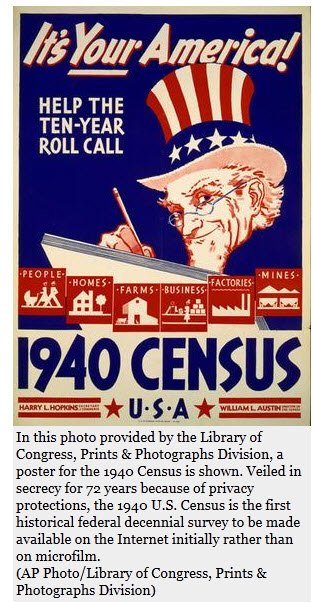
The 72-year wait is almost over!

According to ancestry.com, on April 1, 1940, there were just over 132 million people living in America. Today, about 87% of Americans can find a direct family link to one – or more – of them.

Are you one of the lucky ones?

The 1940 U.S. Census will be opened to the public this April – providing genealogical researchers with a window into each of these 132 million-plus American lives.

What type of information can you learn from the 1940 Census?

There is a lot of information you can glean from the census about your family, including:

  • Their names
  • Where they lived
  • Who lived within their household
  • The relationship of each member to the head of the household (wife, son, daughter, granddaughter, grandson, aunt, uncle, stepfather, etc.)
  • Education (highest grade completed)
  • Place of birth
  • Occupation/Industry
  • Where they lived 5 years earlier (1935)
  • And much more!

The 1940 Census also provides clues to many unanswered questions to genealogy researchers who have “hit the wall” on finding a long lost ancestor.This decade was, for many American families, a time of great upheaval, financial hardship, physical separation and drastic change.

After the Wall Street Crash of 1929, most of the decade was embroiled in The Great Depression, which had a devastating effect not just on Americans, but people all over the world.

Families were separated while one (or both) parents searched for work in other cities or states. In some cases, the death of one or both parents resulted in children being cared for by relatives or placed in an orphanage.

Family ties were often weakened or even broken by events and circumstances.

During the Dust Bowl years, great numbers of farmers and ranchers left their homes in places like Oklahoma and relocated to California and other states. Great migrations of people were happening during this time period, as Oklahomans moved to California; southerners moved north to industrial cities like Pittsburgh, Cleveland and Chicago to find work in factories.

In 1937, famed aviatrix Amelia Earhart disappeared while attempting to circumnavigate the globe. The search for what happened to her and her navigator has continued to this day.

The 1930’s saw not only great financial turmoil, but also the rise of frightening political movements.

The world watched in alarm as Adolph Hitler and the Nazi party came to power in Germany. Their fears were justified when,by the close of the decade in 1939, Hitler invaded Poland and began his quest to conquer the world.

World War II had begun.

For those of us born after 1940, the 1940 U.S. Census offers us a glimpse of what everyday life was like for our parents, grandparents and great-grandparents during the decade preceding America’s entry into WWII.

Maybe a few of you lived through this decade yourself. If you did, I invite you to share a few of your memories with us. Please email KnappNotes@gmail.com and I will post them on the site. Or – please feel free to leave a comment on this posting.

At midnight on April 2, the U.S. National Archives will provide the 1940 Census records to ancestry.com. At that time, ancestry.com personnel will start working to get each page posted online for researchers to use.

I am looking forward to begin using it in my own research. It will be interesting to see what new connections and facts we can unearth as we eagerly scan its pages.

To learn more about the 1940 Census visit: http://www.ancestry.com/1940-census.

To view a blank copy of the 1940 Census form, click this link. By viewing this blank form, you can see what type of information is available on this census.

Posted in Genealogy How To's, Genealogy News | Leave a comment