Mom, Aunt Grace and Euchre

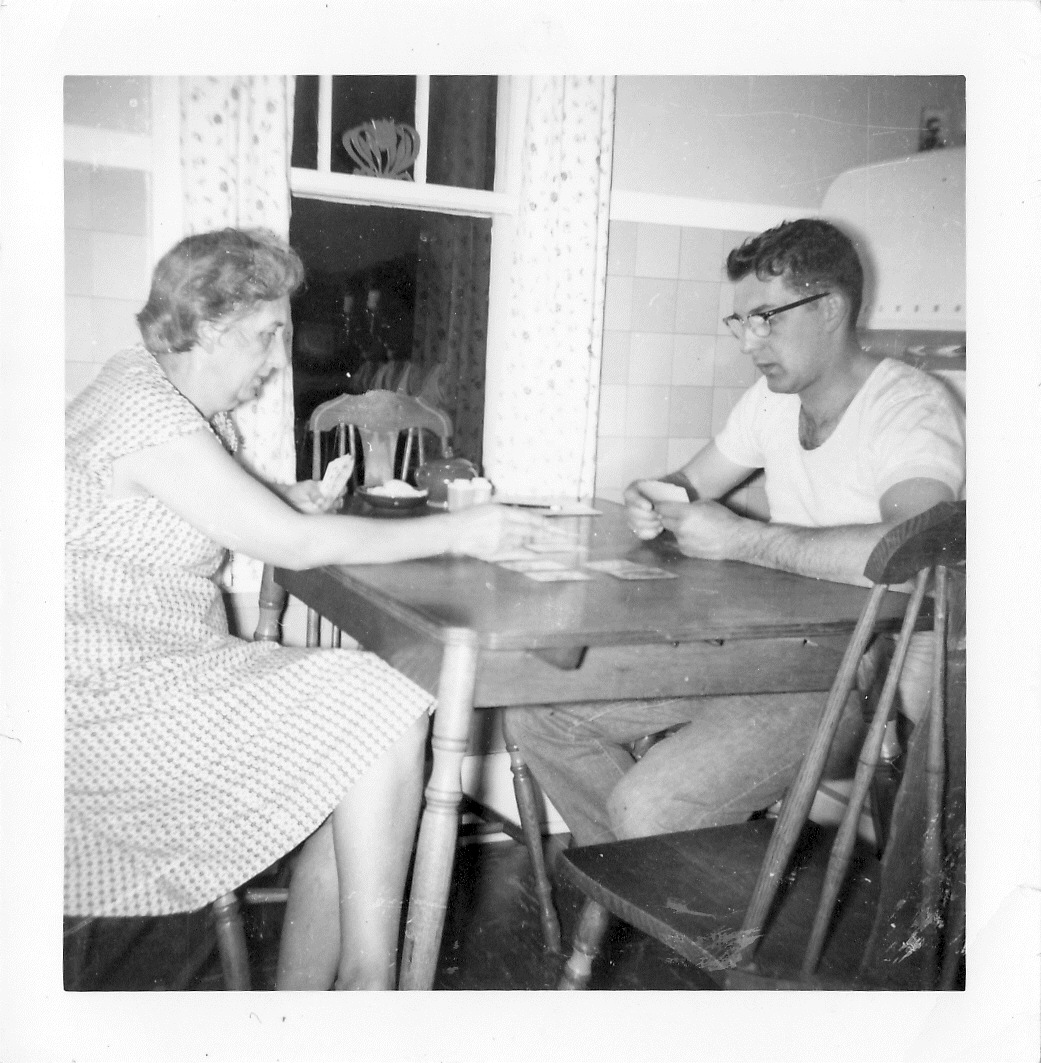
Florence Kline Knapp playing cards with son John P. Knapp Dec. 1955

Gary Knapp sent me this great story about his Mom (Florence Kline Knapp), and her sister, his Aunt Grace Kline Gray, during their card-playing days in the 50’s and 60’s. I will also post a copy on the Stories tab, but it was so good, I just had to share it as a post!

Not long after my dad (John L. KNAPP) died, it was just my mom, ( Florence Kline KNAPP) and me.  We did so many things together.  We were very close.  We took many
trips down to see the old farm in Rootstown and Randolph.  We did a lot of visiting – Uncle Gus in Rootstown, Uncle Joe in Ravenna, Uncle Irvy in Bucyrus, Aunt Martha in Ravenna.

But one of my fondest memories was our visits to see Aunt Grace.

This was in the late 50’s and early 60’s.

It was usually on a Saturday night that we went to see Grace.  I remember that Aunt Grace lived with a friend of hers, I believe her name was Gladys Brainard.

Of course, this was after her husband, Homer Gray, had passed on.

But what I remember vividly was the four of us sitting around a table in this old house in Ravenna playing cards.  I learned from the masters! We played euchre, pinochle, hearts and spades.

Now, I know what you must be thinking. Poor, poor Gary! Having to sit and play cards with those old ladies on a Saturday night!

Well, the truth is, I really enjoyed those evenings and I learned a lot about life from those women.

One thing that really stood out about my Aunt Grace was how she loved to laugh. She was great fun to be around.

Now when I first met my wife, Cathy, I had to get her into the Knapp swing of things – like playing euchre.  She had never played euchre before, so we had to teach her.  I thought she picked up the game pretty quick, but I guess she was not fast enough for my mom.

One day we were playing. Mom and Cathy were partners and Joann and I were partners. Cathy had already misplayed a couple of hands and she was quite flustered.

She was undecided on a move and was taking quite a long time to lay a card when Mom,
(Florence) turned to Joanne and said “How hard can it be, there’s only 5 cards!”

Well everyone started laughing – everyone except Cathy that is.

Since that day, whenever the Knapps play euchre, I look at my wife and say *“How hard can it be, it’s only 5 cards!” and we both laugh.

Posted in Family History, Photos, Stories | Tagged , , , , , | Leave a comment

John Adam Knapp

This is a story about John Adam KNAPP, the “other” Knapp brother.

John Adam Knapp was born 21 Oct 1800 in Wald-Erlenbach, Hesse-Darmstadt, Germany. He died 14 May 1885.  He arrived in America in August of 1832. He resided in Randolph Twp. on a farm located on sections 59 and 69. He was a shoemaker and farmer.

He was also Franz Adam KNAPP‘s youngest brother.

If you read the genealogy information about Franz and his family I posted on the About tab of this blog, you can see that there were THREE John Knapps born to this family.

This was not an uncommon practice.

Infant mortality was high and children often died before they reached adolescence – let alone adulthood. Families often kept naming children the same name until it appeared one of them would survive. This apparently was the case here, since the first Johann did not live past his second birthday. The second Johann did survive, but perhaps he had a different middle name than John Adam did.

Still, the Knapp brothers lived in close proximity to each other. If you check the Document Gallery section of this site, I have posted an excerpt of the 1840 U.S. Census, which lists both brothers living a few doors down from each other in Randolph.

The following account of John Adam KNAPP’s journey to America and his life in the United States is taken from Msgr. Pfeil’s Historical Sketch and Reminiscences of St. Joseph’s Church (1931).

John Adam Knapp, one of the pioneer settlers of Randolph Township, Portage County, Ohio, and one of the founders of St. Joseph’s parish, was born in Wald-Erlenbach, a small village in Hessen Darmstadt, Germany, in the year 1800. His early youth saw the sufferings and ravages of the incessant wars of the Napoleonic era; two of his older brothers having participated in the ill-fated Russian campaign. Like numbers of others, who found the struggle for a decent livelihood a severe one, he resolved to emigrate from Germany to the United States, whose opportunities were attracting large numbers of people from many parts of war-torn Europe.

After a voyage on a sailing ship lasting three months, during which the immigrants were forced to endure great privation and hardships, he and his family landed at Baltimore in the summer of 1832. Pursuing their journey overland by ox team and canal-boat, they finally, after weeks of weary travel, reached Warren, Ohio, where the office of the Connecticut Land Company was located. Warren was then a frontier town of a few log houses. Beyond lay the wilderness, with here and there a little village and the widely scattered cabins of the hardy and daring early settlers. Wild animals abounded and roving Indians were frequent visitors at the white men’s cabins. They were mostly peaceful, as there is no record of violence or open hostilities in this section at the time of which we are speaking.

Leaving his family at Warren, he started out afoot and alone, to find a brother, Francis Adam, who had come to American a year previous and had located in a German Catholic settlement in Randolph Township, somewhere to the southwest of Warren. He travelled through the dense woods, following paths and trails marked by blazed trees, inquiring, with the scant English he had acquired since landing at Baltimore, for the location of this settlement at the few habitations he found on his toilsome trip, and on the second day was told of such a place a few miles farther on. Pushing on, with renewed hope and courage, he arrived at a cabin in a little clearing. Going to the door, he saw a pair of shoes setting outside, and looking closer he recognized them as a pair he had made in Germany for his brother before the latter started for America. (Mr. John Knapp was a shoemaker by trade.) His joy can well be imagined after his anxious search had ended so successfully. Returning to Warren, he bought a parcel of land near his brother’s, and immediately settled on it with his family.

Clearing the land was the next job. A truly Herculean task it was, as the land was so densely wooded that trees had to be cut down to provide a place to build the first log cabin. Their method of clearing the land was to cut the felled trees, some of them of immense size, into logs of a length that could be drawn or rolled into piles and then set afire after they had dried sufficiently to burn. Having no ox team of his own during the first few years, he would hire a team for such work as rolling logs and plowing the little patches cleared. Mr. Knapp often mentioned Thomas Gorby as the best worker with his ox team. Mr. Gorby was the grandfather of Gorby Simmison, who was named after Gorby.

The hardships and privations which the early pioneers endured would deter most of the present generation from attempting to gain a livelihood under such conditions.

During the winter months Mr. Knapp would work at his trade in making new shoes and repairing old ones. Sometimes he would make a round of professional visits among the scattered pioneer homes with his tools and materials in a bag slung across his shoulders, and as money was scarce, would get some provisions, chickens or a meal in exchange for patching or half-soling the worn footwear of the settlers. Some years afterward when they had a few cattle, these would sometimes go astray and be lost for days in the dense woods. Fresh cows which had not been milked during such straying periods would be in bad condition to furnish the supply of milk which constituted an important part of the diet of the family, especially of the children.

As the years passed, the strip of cleared land grew larger and with it the crops increased. Expenses also increased with the growing family, which now numbered seven children, six girls and one boy.

The children were Nancy (Mrs. John Trares), Elizabeth (Mrs. Nicholas Horning), Eva (Mrs. Joseph Paulus), Peter, Mary,(Mrs. John J. Wise), Rosa (Mrs. Bernard Wise) and Margaret, who never married.

The only son, Peter, named above, died at the age of twenty years. Mrs. Knapp, wife of John, Elizabeth, nee Andes, died about 1872. After her death, the youngest daughter, Margaret, kept house for her father until his death in 1885.

The original homestead passed into the hands of his daughter Nancy and her husband (John Trares). They kept the house and barn, both of which are still standing and are kept in good condition by the present owner, Frank W. Paulus, a grandson of the Mr. Knapp who is the subject of this paper, and has spared neither labor nor expense in adding buildings and modern improvements; such as a water supply, electric light and power, etc., thus affording all the comforts and convenience of a city home. It is gratifying to the numerous descendants to see the old ancestral home that witnessed the early struggles and indomitable courage and patient toil of this pioneer family in hands that preserve the ideals of its founder.

During the first few years after their arrival, the spiritual needs of this little colony of Catholics were attended by missionaries who, travelling on horseback, made a circuit of the widely scattered missions and visited these outposts of civilization at more or less regular intervals. Some of these missionaries later were raised to the episcopate, among them being the saintly Bishop Neumann of Philadelphia and Archbishop Henni of Milwaukee, and Bishop Rappe, the first bishop of the Cleveland Diocese. The home of ‘Shoemaker’ Knapp (for so was he known among his friends) was for a long time the stopping place for these missionaries during their visits, and later when a resident priest was appointed, he lived there until a parish house was built.

When his eyesight began failing when he was quite advanced in years, Mr. Knapp consulted a specialist, Dr. Portman of Canton, who frankly told him he could not hold out much hope for restoring his vision. Eager to recover at least partial sight, he risked an operation, which, however, was not successful, and caused him much suffering and left him totally blind during the last six years of his life. He bore this affliction with patience and resignation. He died, well-fortified with the sacraments of Holy Mother Church, in June, 1885.

May he rest in peace with his God whom he served so faithfully.

Only a few points need clarification. His first land purchase was not until June 6, 1838, when he bought 127 acres in Randolph Twp. secs. 59 and 69 from Isaac Vangorder of Warren in Trumble Co. (price: $414). His wife actually died July 2, 1871, and he died in May, not June. Elizabeth Andes was baptized Ap. 18, 1804. She married John, then a shoemaker in Erbach, at St. Peter’s, Heppenheim. He was baptized Oct. 21, 1800, the son of John Knapp and Anna Elizabeth Jacob. (According to an article in the Portage Co. Democrat (1875) he was also born on Oct. 21.) The Knapps were an astonishingly prolific clan, but the other children of John Sr. and Anna Jacob are outside the scope of this history. And, mercifully, all the descendants of John Jr. and Elizabeth Andes are by way of their daughters and have names other than Knapp. A. Nancy (Trares) 1830-96 B. Elizabeth (Horning) 1832-1901 C. Eva (Paulus) 1837-1906 D. Peter 1839-1860 E. Mary (Wise) 1842-1923 F. Rosina (Wise) 1844-1902 G. Margaret 1847-1926

Endnotes

1.  http://birkenhoerdt.l-s-s.net/getperson.php?personID=I30845&tree=suedpfalz

2.  Death Certificate

3.  Information extracted from the book: The Descendants of PETER ANDES SR. and MARIA ANNA ARTZ Through Four Generations in America Including the History of the Schroeder (Schrader) Family by Richard J. Schrader and Mary Jayne Aylward 1983 Revised Ed.

4.  From a family tree on ancestry.com

http://trees.ancestry.com/tree/4230/person/-217058512/media/1

Just in case you’re wondering where Wald-Erlenbach, Hesse is in Germany, you can take a peek at this map. FYI: it is located south of Frankfurt and Wiesbaden in Germany.

Posted in Family History, Maps, Stories | Tagged , , | Leave a comment

Father Neumann

In 1841, a 29-year-old priest was sent by his bishop into the sparsely-settled and heavily wooded Portage County, Ohio wilderness. His mission? To settle a squabble among German Catholic settlers in the community of Randolph.

The strife amongst the families of St. Joseph’s Church had reached the boiling point. A wood frame church building, erected in 1838, had been burned to the ground.

The young priest was Father John Nepomucene Neumann, born in 1811 in Prachatitz, Bohemia. Father Neumann apparently did a good job of settling the dispute between the parishioners. He remained only 10 days in Randolph, preaching and baptizing two residents.

St. Joseph’s was the first Catholic parish in Portage County.

But the story of Father Neumann doesn’t end at St. Joseph’s in Randolph.

Father Neumann graduated from the seminary in Prague (in what is now Czechoslovakia), then emigrated to the United States in 1836 at age 25. He was ordained in New York and did some missionary work in New York state for four years.

Bishop Purcell of Cincinnati had visited the argumentative congregation at the church in Randolph on Nov. 12, 1841, with the intention of settling the ongoing quarrel. The church had been founded by immigrants from a German-speaking part of Alsace-Lorraine in France, and who had come to Randolph in 1826. The bishop decided it was a better assignment (and perhaps a test) for the young Father Neumann.

Father Neumann’s peace-making efforts at St. Joseph’s did not go unnoticed – or unrewarded.

In 1852, he became bishop of Philadelphia, serving until his death in 1860 at age 49. Though Bishop Neumann’s life was short, he accomplished a tremendous amount of work for the children in the city he served.

He was particularly interested in providing a Catholic education for Philadelphia’s children. When he became bishop in 1852, there were only two Catholic schools in Philadelphia. When he died, there were almost 100 Catholic schools in the city. He also helped to bring several European orders of Catholic nuns to America to staff the schools as teachers and administrators. He also founded a branch of the Sisters of St. Francis in Philadelphia.

Father Neumann became a U.S. citizen in 1848. In 1963, he was beatified, and in June 1977, he was canonized – and became the first male American citizen to become a saint.

The information in this post was taken from the book Portage Pathways by Loris Troyer, a retired editor of the Kent Record Courier. You can read more about the history of Portage County in Troyer’s book. It is available at Amazon by clicking here.

You can also read more about the life of Father Neumann at a website maintained in his honor by the Friends of St. John Neumann organization.

Posted in Local History, Ohio Churches, Portage County | Tagged , , , , , | 1 Comment

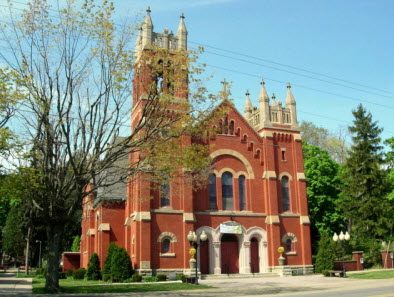
St. Joseph Catholic Church

St. Joseph Church in Randolph/Suffield, Portage Co., Ohio

The Knapp family has a long history with St. Joseph Catholic Church located in the village of Randolph, Portage County, Ohio.

In fact, our immigrant ancestor, Franz Adam KNAPP, donated the land where St. Joseph Church and Cemetery now stand.

Mark and I had the opportunity during one of our visits to peek inside the church and we found a plaque commemorating Franz’s donation on one of the church’s walls.

You can read more about the history of St. Joseph parish on their site, although no mention is made of Franz’s generosity on the website. To read an article about St. Joseph’s celebrating their 175th Anniversary in 2006, click this link.

If you are ever in the area, the inside of the church is worth a look.
View Larger Map

Unlike a lot of older churches, it is bright and airy – not the least bit dark and dim. Obviously, the designer was way ahead of his time in making sure the sanctuary was a peaceful and sunny place to worship. The style is simple, but quite beautiful.

But don’t take my word for it – you can click this link to St. Joseph’s photo album on their site to see pictures of the inside and outside of the church, the Lourdes Grotto Shrine and other photos.

Click this link to see some photos of the beautiful old cemetery that lies next to and behind the church.

There are many Knapp kin buried there. Just a few of the surnames of relatives you will find buried there include: Knapp, Trares, Paulus, Moledor/Molitor, Andes/Antes, Horning, Arehart, Mai/May, Schrader/Schroeder, and Wise.

A fellow genealogical researcher, Mike Schwitzgebel, has generously shared some photos of St. Joseph tombstones on the U.S GenWeb Ohio Tombstone Project on the GenWeb site.

Didn’t I tell you that genealogists are generous and helpful people?

For those of you who aren’t genealogists, the U.S. GenWeb Project is devoted to making genealogical records FREE and available online for all researchers. I am planning to start photographing Knapp and Kline tombstones to upload to this page myself.

But thanks to Mike, he has some of the family covered already. He has some photos of ANDES/ANTES tombstones. And Mark’s Aunt JoAnn may appreciate the photos of the GRIGGY/CRIQUI  stones.

Way to go, Mike!

By the way, here is a link to Mike’s site where you can find a lot of information about some of our common ancestors. I used the information on Mike’s site to track down a lot of family history.

Stay tuned for a post about the Kline side of the family’s “home church,” St. Peter of the Fields located in Rootstown!

Posted in Family History, Local History, Maps | Tagged , , , , , | 3 Comments

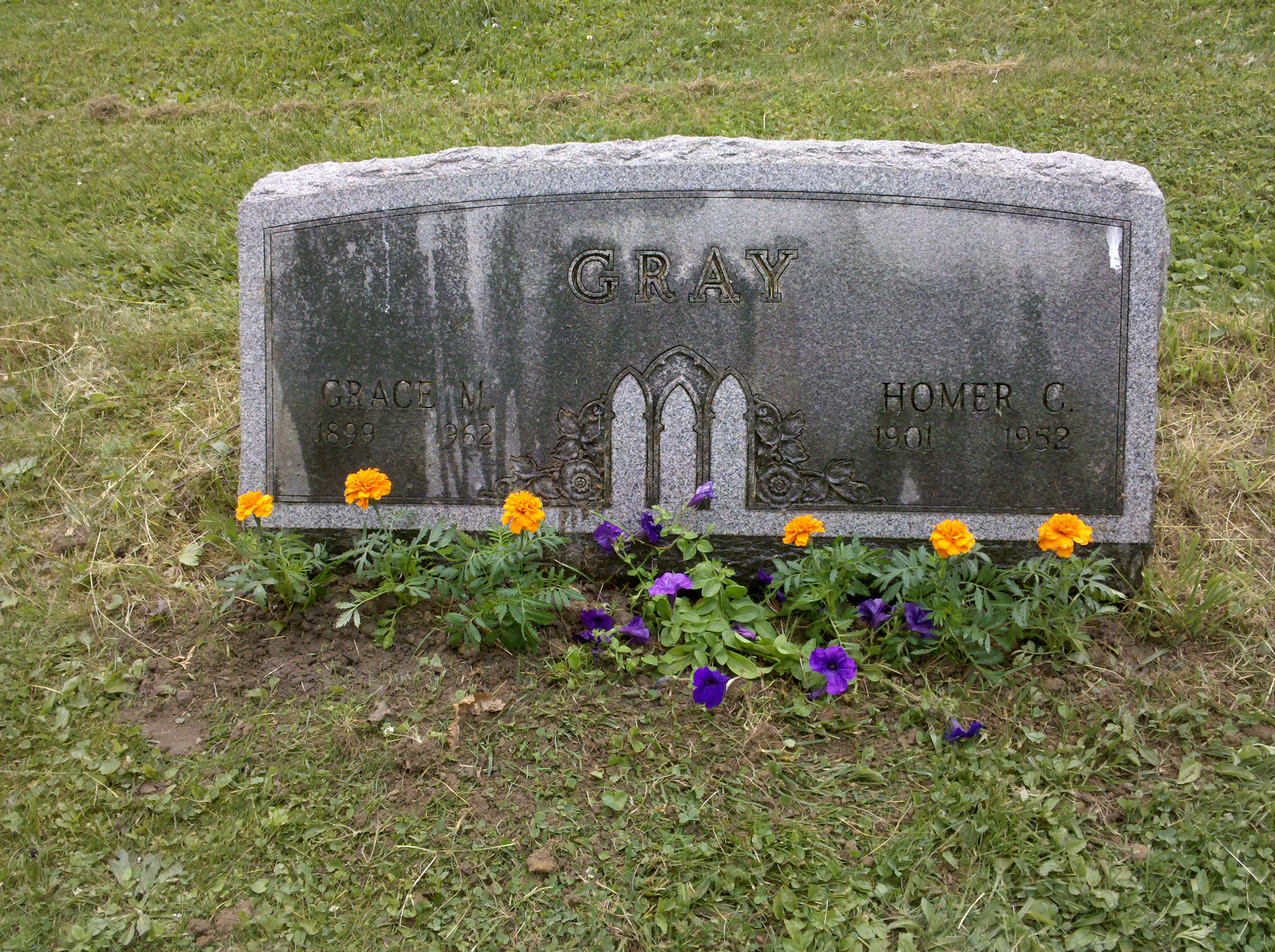
Flowers for Grace

Graves of Grace and Homer Gray, Maple Grove, Ravenna, Ohio

Genealogists are a strange bunch. Just ask my son.

Since he was old enough to walk, he has accompanied me on many a jaunt to a cemetery to go grave-hunting for long, lost ancestors. We would comb the rows of tombstones, trying to find where great-great-grandpa Casper was buried.

Eureka! We found him, we’d whoop!

Even though he was just a small boy, he was never afraid to go with me.

“You have nothing to fear in a cemetery – remember, it’s the living you have to worry about, son, not the dead,” I always told him.

I think he was as fascinated with some of the tombstones and the stories they told as I was.

When he was a little older, I took him to Memorial Day observances at the local cemetery. I felt it was important that he know about the sacrifices that our veterans have made.

When he was a little older, I watched him march in his Cub Scout uniform in the Memorial Day Parade. Later, as a teenager, just as I had done twenty years before, he marched in the Memorial Day Parade as a member of the high school band.

I thought about all that when my husband and I drove out to Maple Grove Cemetery last Monday morning.

The cemetery was full of people, as the Memorial Day Parade had just ended. Parents, children, grandparents…people were headed back to their cars, or placing flowers, or stopping by a grave to remember a loved one.

We were there to plant flowers on Mark’s great aunt’s grave. While researching the Kline side of the family, I had found great aunt Grace’s obituary last summer.

I realized, after reading it and then talking to my father-in-law, that she and her husband, Homer Gray, had never had any children.

My husband offered to go with me to Ravenna to see if we could find her grave at Maple Grove.

After a lot of walking, we finally found it! But there were no flowers on it. Clearly, no one was tending this grave.

And that bothered me.

After all, I had grown up watching my own mother (and grandmother) faithfully tend our family’s graves. Every fall, my mom collects the flower pots, discards the dead flowers and stores the empty pots in the garage.

Then, just before Memorial Day, she buys new flowers, replants them and hauls them to the cemeteries so the graves look nice for Memorial Day.

My grandmother is gone now and my mother is 75 years old with a heart condition – but she still does this every year. I know when she can’t do it any longer, it will be my turn.

It’s a family tradition.

So Mark and I decided to “adopt” great aunt Grace and great uncle Homer’s graves and decorate them for Memorial Day.

So that’s why we were at Maple Grove last Monday, just planting a few flowers.

Below is Aunt Grace’s obituary, which ran in the Ravenna Record Courier on May 31, 1962. If anyone has a photo of Aunt Grace, please email it to Knapp Notes so I can post it to the Photo Gallery.

If you click on the photo of Aunt Grace’s tombstone above, you can see a larger version of the photo. Aren’t cell phone cameras amazing?

I have also included a picture of Mark wielding his trowel in the Photo Gallery, in case you want to check it out.

Grace K. Gray

Mrs. Grace K. Gray, 63, of 131 N. Walnut St., Ravenna, a receptionist in the office of Dr. Earl O. Stevens for more than 35 years, died in Robinson Memorial Hospital at 7:05 p.m. Tuesday.

Ill since last August, Mrs. Gray was admitted to the hospital March 9. Her husband, Homer, died in 1952.

Mrs. Gray was born in Rootstown, April 10, 1889, and had been a resident of this area her entire life. She was a daughter of the late Mr. and Mrs. Henry C. Kline. She was a member of the Immaculate Conception Church.

Surviving are three brothers, Ervin Kline of Bucyrus, O., Gus Kline of Rootstown, and Joseph Kline, Ravenna; and a sister, Mrs. Florence Knapp of Kent.

Requiem mass at the Immaculate Conception Church will be at 9 a.m. Saturday. Burial will be in Maple Grove Cemetery. Friends will be received at the Wood Funeral Home, Ravenna, from 7-9 p.m. Friday.

Posted in Family History, Photos | Tagged , , , , , , | Leave a comment

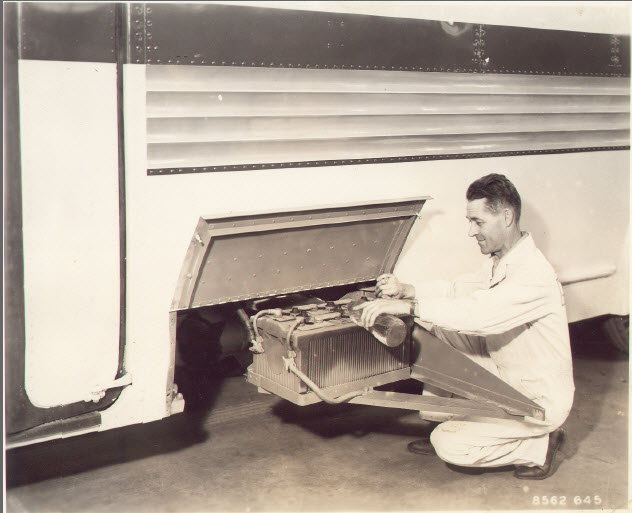
John Lewis Knapp and the Twin Coach Company

John Lewis Knapp at Twin Coach, Kent, Ohio

John Lewis KNAPP was good with his hands – if it had an engine and four wheels, he could fix it! He put his mechanical aptitude to work as a mechanic at the Twin Coach Company.

According to my husband’s uncle, Don Knapp, his dad was responsible for keeping the owners’ personal motorcars running. He was also heavily involved in helping the founders with their brief venture into the sport of auto racing, including a car that ran at the famed Indianapolis Speedway.

But more from Uncle Don on that later. Don has promised to provide more information about his dad’s venture into auto racing that will be featured in a later post.

First, some background on the Twin Coach Company.

Founded in Kent, Ohio in 1927 by brothers William B. and Frank R. Fageol, the company started making trucks in California during World War I, as well as automobiles for domestic use. They brought their “Safety Coach” east in 1923, and settled in Kent, Ohio in 1924 as the Fageol Motor Company.

The company was sold to American Car and Foundry Company of Dayton, Ohio, in 1925.

In 1927, the Fageols’ developed a new form of public transportation called the “Twin Coach,” the first urban motor coach. The Fageols re-established themselves in their original Kent location as the Twin Coach Company.

The Fageol Motors and Twin Coach companies were instrumental in the history of public transportation in the United States. The dual-motored “Twin Coach” was the first urban transit or streetcar-type motor coach. The Twin Coach Company ranked second in urban bus manufacturing for approximately twenty years. The company also manufactured airplane parts and machine engines, as well as a new house-to-house mail delivery truck called the “Pony Express.”

In 1958, Twin Coach sold its marine engine business and moved its headquarters to Cheektowga, New York. In 1962, stockholders approved a name change for the company and the Twin Coach Company became Twin Industries Corporation.

I am willing to bet that no one knows there is a “Twin Coach Song.” This is sung to the tune of the Army song “Those Caissons Keep Rolling Along.”

1st Verse

They will work with a will,
Every Twin Coach man – until
All our buses are rolling along.
We won’t stop – we won’t stop
‘Till America’s on top,
And the Axis is broken and gone.
2nd Verse

On the job day and night
While our soldiers dig and fight,
There is work for each Patriot to do.
One for all, all for one
We will get those buses done.
They will roll ‘till the whole thing is done

Chorus

Then it’s Hi Hi Hee
The Twin Coach Company.
Chins up, our zeal will never lag,
With all our might
We will win the fight
For our country, our Home and our Flag.

If you wish to learn more about Twin Coach and its history in Kent, here are a few links to some websites you might find interesting:

Posted in Family History, Local History | Tagged , , , | 6 Comments

Sharing the Wealth

Genealogy is all about sharing the wealth.

Some of the most generous, helpful people on the planet today are genealogists.

Most of them are always willing to help someone new to genealogy research,  share what they have learned during the course of their own research, or offer helpful tips on where someone can pursue a new lead to track down an elusive family connection.

I have been the happy recipient of such assistance many times during the course of my own research. A distant cousin whom I have never met in person provided the missing link that allowed me to connect my family line with other ancestors in southern Ohio. Without her help, I would never have made the connection between the two families.

This exchange of information happened online. I have still never met this kind lady face-to-face, but I am grateful that today’s technology has enabled us to meet and chat in cyberspace!

That is one reason I decided to start this blog – to share the wealth.

While I am not a Knapp by blood (I only married one!), I have been researching my husband’s family tree for the past few years. I decided not long ago that I wanted to put my research online so others can access it, too.

I feel strongly about sharing this information with others. You learn a lot about yourself when you learn where you came from. History becomes more real – not just a series of dates and places and names to memorize in school, but real events that happened to real people.

If you want to spur an interest in history and geography in your children, start telling them about family members who participated in some of the major events they learn about every day in school.

History becomes personal when you know that an ancestor was a soldier during the Civil War, witnessed the carnage and bravery on D-Day, or crossed the prairie in a covered wagon.

History comes alive when you try to imagine what it felt like to stand on the deck of a ship after crossing the storm-tossed Atlantic and steam by the Statue of Liberty on the way to Ellis Island – the gateway to the United States!

And as you learn to ask your elderly relatives about their lives and their memories, you gain something that is truly priceless. My advice: don’t wait. Start asking those questions now – before it is too late.

When I was a newspaper reporter, part of my “beat” was the Ohio Veterans Home in Sandusky, Ohio. I heard someone say that every time a vet died there, a history book was lost – gone forever.

That statement resonated with me. And I realized that it isn’t only true of veterans, but of ALL our elderly citizens. Each and every older person is a virtual treasure trove of stored memories, unique perspectives and experiences.

Don’t waste an opportunity to sit down with them, ask questions, and record the conversation. These living “history books” won’t be around forever. Talk to them before they are gone or their memories dim with age.

Don’t wait – make that call or stop by for a visit – today!

Posted in Family History | Tagged , , | Leave a comment

Clotilda Knapp Bissler: 1918 Influenza Pandemic Victim

Clotilda Knapp Bissler, 1893 - 1918

John Lewis Knapp’s sister, Clotilda E. Knapp, was born 4 Jan 1893 in Randolph Twp., Portage County, Ohio, to Lewis J. Knapp and Mary M. May. Clotilda was the second child in the family.

Clotilda married Paul Romanus Bissler, son of Joseph W. and Mary Bissler. Joseph Bissler was an older brother of Samuel Bissler, founder of the Bissler Funeral Home in Kent, Ohio. Paul Roman Bissler was born 11 Aug 1894 in Suffield Twp., Portage Co., Ohio.

The young couple had one daughter, Evelyn M., born 22 April 1915 in Suffield Twp., Portage County, Ohio. During the fall of 1918, Clotilda was pregnant with the couple’s second child.

World War I was winding down overseas in France, and her younger brother, Hubert, was serving stateside in the Army. It looked like he wouldn’t have to deploy overseas. The young mother-to-be didn’t realize that soon she would be locked in a life or death struggle of her own with an invisible enemy.

The Americans had joined in the fight, bringing the Allies closer to victory against the Germans.

Then, soldiers and citizens started to get sick – and die. And it was happening all over the world.

A virulent form of influenza ravaged the earth – a fifth of the world’s population was infected.

The flu was most deadly for people ages 20 to 40 – unusual for influenza, which is usually a killer of the elderly and young children.

Some facts taken from Stanford University’s website about The 1918 Influenza Pandemic:

  • The flu infected 28% of all Americans.
  • An estimated 675,000 Americans died of influenza during the pandemic, ten times as many as in the world war.
  • Of the U.S. soldiers who died in Europe, half of them fell to the influenza virus and not to the enemy. An estimated 43,000 servicemen mobilized for WWI died of influenza.
  • The influenza pandemic of 1918-1919 killed more people than the Great War, known today as World War I (WWI), at somewhere between 20 and 40 million people world-wide.
  • More people died of influenza in a single year than in four-years of the Black Death Bubonic Plague from 1347 to 1351.
  • Known as “Spanish Flu” or “La Grippe” the influenza of 1918-1919 was a global disaster. The effect of the influenza epidemic was so severe that the average life span in the US was depressed by 10 years.

This flu attacked quickly – and the younger and healthier the victim, the more savage the attack. Some victims died within hours after the initial onset of symptoms.

The death rate for 15 to 34-year-olds of influenza and pneumonia were 20 times higher in 1918 than in previous years. People were struck with illness on the street and died rapid deaths.

One anecdote shared from that fall of 1918 was of four women playing bridge together late into the night. Overnight, three of the women died from influenza. Others told stories of people on their way to work suddenly developing the flu and dying within hours.

It isn’t known when Clotilda Bissler got sick, but she gave birth to a son born prematurely on Oct. 10, 1918. The baby boy, Joseph L. Bissler, died the following day, on Oct. 11, 1918. His young mother followed him to the grave on October 12, 1918.

The doctor listed the cause of death on Clotilda’s death certificate as lobar pneumonia and premature labor. Also listed as a contributing factor to her death was La Grippe.

The Great Pandemic of 1918 had claimed two more victims.

Paul married his second wife, Martha M. Winkler. But sadly, tragedy struck a second – and a third time – for Paul Bissler.

First, his daughter, Evelyn, the child from his first marriage to Clotilda, died in 1927 of myocarditis caused by scarlet fever at the age of twelve.

Then a tragic car accident in May 1943 claimed the lives of two of his young sons from his marriage to second wife, Martha. Paul and Joseph Bissler were killed in a car accident while they were riding with their father on May 31, 1943.

Paul R. Bissler died 9 Dec 1961 at Robinson Memorial Hospital in Ravenna, Ohio. Martha Winkler Bissler passed away on 29 Jul 1986 in Stow, Ohio.

One of Paul and Mary’s daughters, Mary, married Dick Richards, a Kent area florist and Knapp family friend. Mrs. Richard H. (Mary) Richards of Kent is listed on Martha’s obituary as a survivor, along with sons, William of Suffield, David of Rootstown and Daniel of Maui, Hawaii; and another daughter, Andrew (Betty) Karaffa of Wheat Ridge, Colo.

You have to admire the tenaciousness of our ancestors – and their courage in pressing on despite adversity and tragedy. Whatever challenges life threw at them, they just kept putting one foot in front of the other and moving forward.

REFERENCES

If you want to learn more about the 1918 Flu Pandemic, check out Stanford University’s site about the pandemic. This is the source of the statistics I mentioned in the blog post.

Posted in 1918 Flu Pandemic, Family History, Local History | Tagged , , , , , | 2 Comments

Hubert Joseph Knapp – An American Doughboy

Hubert Joseph Knapp (1896 - 1975)

Hubert Joseph KNAPP was born Nov. 15, 1896 in New Milford, Portage County, Ohio, to his parents, Lewis J. KNAPP and Mary M. MAY.

He was their fourth child. His siblings included his brothers: Eugene, John and Raymond, and his sisters: Clotilda, Beatrice, and Estella.

He married Margaret Susan WISE on Nov. 27, 1923, in St. Joseph’s Catholic Church, Randolph, Portage Co., Ohio.

Margaret was the daughter of Henry Andes WISE and Mary Clara SCHUMAN.  Eight children were born to the marriage, including: Dennis, Marguerite, Richard, Walter, Francis, Eleanor, Mary Jeanne, and an unnamed child that died Oct. 24, 1934.

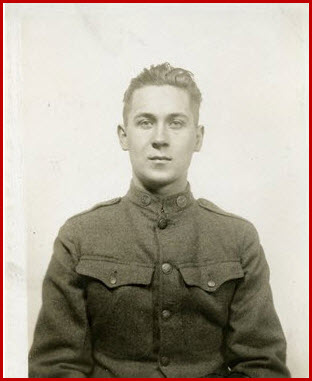
Hubert served in World War I, as shown by the photo of him in his doughboy uniform. He was assigned to the 158 Depot Brigade to Oct. 2, 1918. Then to the AS Flying School Detachment at Wilbur Wright Field near Dayton, Ohio to discharge. He served as a Private and received an honorable discharge on March 25, 1919.

Hubert died Sept. 29, 1975, in Ravenna, Portage Co., Ohio. His wife, Margaret, died Feb. 25, 1992, also in Ravenna, Ohio. Hubert and Margaret are both buried in St. Mary’s Catholic Cemetery in Ravenna, Ohio.

Posted in Family History, Photos | Tagged , , , , , | Leave a comment

Calling all Knapp descendants…it’s family reunion time!

There is a Knapp Family Reunion scheduled for Saturday, July 24, 2010 at Silver Springs Park in Stow, Ohio.

This blog is designed to help members of the extended Knapp clan keep in touch and know what’s happening for each family reunion. Plus it’s a way that our resident family history buffs can post their genealogy research online and share it with other members of the family.

We hope we are re-starting a worthwhile tradition that can continue for many more years to come. But we can’t do it alone – we need your participation, too!

If you aren’t sure where you or your family “fit” on the Knapp family tree, click on the Our Heritage tab, where we’ve posted family history information. This tab is password-protected, but if you send us an email, we’ll send you the password.

We are planning to post more family stories, photos, and recipes on this blog. If you have something you would like to share, please contact us so we can post these items. Click on the About tab for more information about how to get in touch.

Please keep checking this blog – we will be posting more information about the reunion during the coming weeks.

Posted in Family History | Tagged , , , , | Leave a comment